Fasteners 101 – Bolts, Screws and What makes them work
Threaded Fasteners
This post is to support your learning before we meet synchronously to recap what you’ve discovered in regards to bolts and screws. Please take some time to read through, click on some linked resources, test your knowledge with the interactive animation, and if you’d like – try some of these new skills around your house!
What exactly is a fastener – and why does it matter?
Everyday objects, machines, furniture, vehicles—the unseen force holding much of it together is fasteners. The term fastener broadly covers screws, bolts, nuts, rivets and more, but for our purposes we will focus on threaded fasteners—the ones with helical grooves that clamp material together.
If you want a quick visual overview before diving in, check out this short “fasteners 101” video:
Understanding fasteners isn’t just about picking the right size—it’s about knowing how they work, how they engage, how they hold, and what happens if you choose the wrong one.
Bolt vs. Screw – Clearing the confusion (kind of)
One of the first places confusion arises is whether a given piece of hardware is called a bolt or a screw. Many people use the terms interchangeably, but there are subtle (and important) differences.
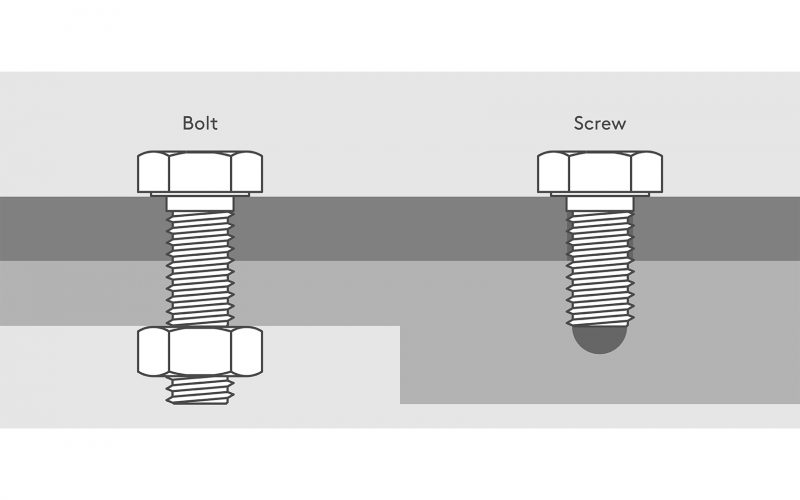
Technically Correct
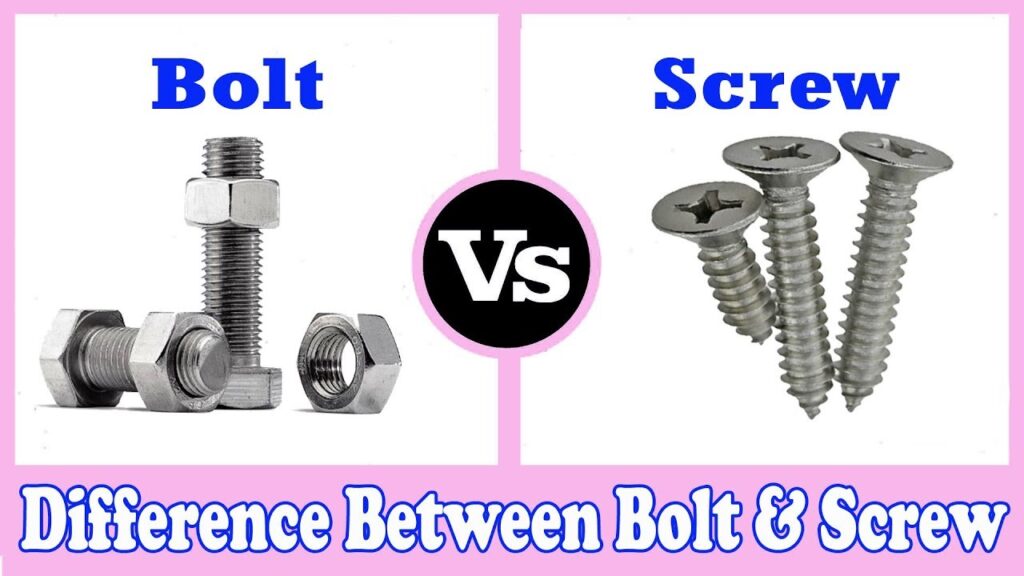
Practical Terminology
According to standard references, a bolt is typically defined as “an externally threaded fastener designed for insertion through holes in assembled parts and normally intended to be secured by a nut.” Meanwhile, a screw is “an externally threaded fastener capable of being inserted into holes in assembled parts, of mating with a pre-formed internal thread or of forming its own thread, and of being tightened or released by torquing the head.”
Still confused? I’ve got more for you. In practice the line blurs – some screws use nuts, some bolts drive into tapped holes, some dart straight into unthreaded material, etc. A great video that walks through this nuance:
Here are the key things you should take away from bolts vs screws:
- A “bolt” often implies the use of a nut (or a threaded counterpart) and typically passes through unthreaded parts.
- A “screw” often goes into a part that either already has threads or is going to have them cut as the screw advances.
The major identifiers: Diameter, Length (penetration depth) & Pitch
Having cleared the bolt vs screw question, we should spend some time to understand the physical attributes that determine what a fastener is and how it functions.
Diameter (the thickness)
When you see a specification like “M10” or “½ inch”, that is referring to the nominal diameter of the fastener – the major diameter of the thread (i.e., the outermost thread crest). For example, in metric you may see “M10 × 1.5” meaning a 10 mm diameter bolt. In imperial you might see “½-13 UNC” meaning half-inch diameter.
Diameter matters because it affects:
- The clearance or hole size required
- The strength of the fastener (larger diameter = more material = stronger or “higher tensile strength”)
- The compatibility with nuts or tapped holes
Here’s a nice diagram showing major diameter, pitch diameter, minor diameter:
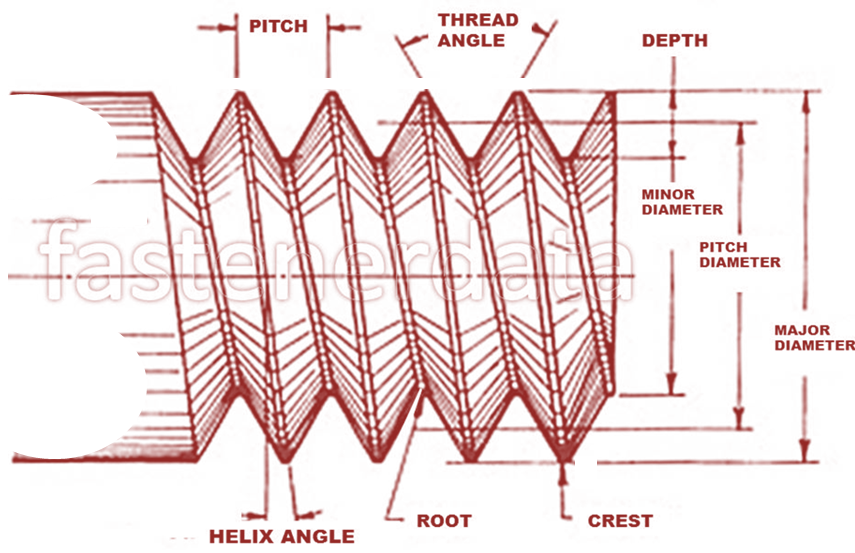
https://www.fastenerdata.co.uk/screw-threads – Link to this picture – great additional reading!
Length / Penetration Depth
Length is how far the fastener will extend (or engage) in an assembly. But “length” can mean different things depending on the head style (did you measure from under the head or from the top?), and “penetration” can refer to how deep the threaded part goes into material or how much shank vs. thread remains engaged.
Here are some things to keep in mind:
- For a typical hex-head bolt (non-countersunk) you measure from the underside of the head to the tip of the bolt.
- For a countersunk head screw you measure from the top of the head because the head sits flush.
- If only part of a bolt is threaded, you may also care about how many threads are engaged and how long the un-threaded shank is (for shear vs tension loads).
- If the bolt is too short, you risk not engaging enough threads or not compressing the parts properly. Too long, and you might interfere with other components or cause clearance issues.
Thread Pitch
Finally we get to thread pitch and Threads Per Inch. Thread pitch is the distance between adjacent threads in metric systems (e.g., 1.25 mm). In imperial systems the comparable measure is “threads per inch” (TPI) — e.g., 20 TPI means there are 20 threads in one inch of length.
This distinction is well explained in this video:
Why pitch (or TPI) matters:
- It determines how fast the fastener advances per turn (one turn on a coarse thread moves more than one turn on a fine thread).
- It affects clamp force, adjustment precision, and how the load is shared across threads.
- Using the wrong pitch (mixing metric and imperial, or coarse vs fine) can lead to damage of the threads, incorrect fit, or failure.
Let’s put it all together – some examples
Imagine you’re specifying a fastener. In metric you might write:
M10 × 1.5 × 40
Meaning: 10 mm major diameter, 1.5 mm thread pitch, 40 mm length.
In imperial you might write:
½-13 UNC × 2¾″
Meaning: ½-inch diameter, 13 threads-per-inch (UNC coarse series), length 2.75 inches.
In real assemblies you’ll also specify head style (hex, countersunk), thread length, material/grade, finish etc. But getting diameter, length and pitch correct is the starting point.
How to measure those three key things
Tools you’ll want
- Digital or dial calipers (for diameter, length)
- Thread pitch gauge (metric/imperial) to match the threads and determine pitch or TPI. There’s a good Wikipedia article on how to use these!
- Ruler or tape measure (for rough checks)
Step-by-step measurement process
Here’s a walk-through of how you might measure a fastener:
1. Measure the diameter
For a bolt that has a shank (smooth part between the threads and the head), place your caliper jaws across the diameter of the shank, for a bolt that has no shank place your caliper jaws across the outer thread crests (major diameter) of the threaded section. Record the reading in mm or inches depending on the type of bolt you have. For accuracy, take multiple readings at different positions (to check for taper or wear).
2. Determine the pitch or TPI
Use your thread pitch gauge:
- In metric: match the gauge leaf to the threads until it fits snugly; read the marked pitch (e.g., 1.25 mm).
- In imperial: use a TPI gauge and corresponding leaf or count threads over an inch to determine how many threads exist per inch.
3. Measure the length (penetration)
Decide what length you need: for a typical hex headed bolt you measure from the flat underside of the head to the tip of the threads. For a countersunk screw you measure from the top of the head (because the head sits flush) to the tip of the threads. Use your calipers to get that reading.
If a video is more your thing, check out this detailed tutorial:
Now that you’ve got the skills to not only know what the difference between a metric and imperial fastener is and what diameter, penetration depth, and pitch is, but how to also measure those three key things give it a shot in this interactive animation seen below (click here to open it in a full screen window – it’s a bit easier to read). Record your answers as we’ll go through them in our sync session!
Sources
https://en.wikipedia.org/wiki/Bolt_%28fastener%29
https://en.wikipedia.org/wiki/Screw
https://www.fastenerdata.co.uk/screw-threads
Hey Kyle,
Great presentation! good amount of information here. I do have a question though. Not sure if this is for automotive or a particular application? I noticed the machine threads on the bolt picture has no “grip” to it. Is this something normal in automotive? I know in aircraft we can not put loads on to threaded portions.
Thanks for your time.
Hey William,
Thanks! You’re right, I probably should have clarified what industry the chunk of this information pertained to!
Yes, this was geared towards the automotive/heavy mechanical trades specifically, where we are most concerned with clamp force & tensile strength vs shear strength. Thanks for the tidbit of information as it applies to the aviation world!
Thanks for all this helpful information!
I always got my screw, nut, bolt terminology mixed up when doing projects. This has helped clarify all of that. 😁 Lots of great information & videos. Thanks.